Pick one of two modes: no tool — change the computer's system proxy or delegate to your AI; or with a tool — from the official extension to common market tools. Same host and credentials for both.
A Proxy302 account and one proxy asset in a usable state (any type). Sign in at proxy302.com and open the workbench; the resource card showing "Generated and ready to copy" means you are set. No asset yet? Buy residential traffic or a static ISP line first.
Then pick a mode: without a connection tool (system proxy, terminal, code — or hand it to your AI), or with a connection tool (our extension and helper tool, plus common tools like SwitchyOmega, Proxifier and antidetect browsers). Both modes use the same credentials and you can switch anytime.
With one set of credentials (host, username and password from the workbench resource card) you can connect without installing anything: set the system proxy for the whole machine, hit the gateway with curl, or pass proxy options in code. In a hurry? Send the instruction below, together with your credentials, to your AI assistant and let it do the work.
Scroll horizontally with the arrow keys to read all content.
Please switch this computer's proxy to Proxy302:
1. On Windows open "Settings → Network & Internet → Proxy → Manual proxy setup",
   set the address to proxy.proxy302.com and the port to 2222.
   On macOS open "System Settings → Network → Details → Proxies → Web Proxy",
   fill the same values and enter the credentials in the authentication fields.
2. Proxy username "your-username", password "your-password"
   (from the proxy302.com workbench resource card — "Copy all").
3. Visit https://ipinfo.io/json afterwards and read me the exit IP and country.
4. If my line is SOCKS5, use port 3333 instead.
Send this plus your credentials to any AI assistant and it can do the setup and verification for you; on Windows the browser shows a proxy sign-in dialog on the first request, once.
Windows: "Settings → Network & Internet → Proxy", turn on "Use a proxy server", address proxy.proxy302.com, port 2222. macOS: "System Settings → Network → Details → Proxies → Web Proxy", same address and port; username and password go straight into the authentication fields.
Expected result: The system proxy switch is on.
Handle the sign-in dialog
The Windows system proxy has no credential fields: on the first page request the browser shows a proxy sign-in dialog — enter the username and password from the resource card once. macOS will not ask again after you filled them in Settings.
Expected result: Asked once, then never again.
Verify the exit
Open ipinfo.io; the IP and country shown are the proxy exit. They match the line you bought, the proxy is working.
Expected result: Exit country matches your line.
Before continuing: The system proxy applies to the whole machine — turn it off when you stop using it, or every app waits on a dead proxy when the network drops.
Command line: curl in two minutes
Put the credentials in a local config file
Create an empty proxy302.conf and restrict it to your own user before writing credentials (POSIX: touch proxy302.conf && chmod 600 proxy302.conf; Windows: restrict file permissions first). Then copy the block below and replace the placeholders. Keep passwords out of shell history and process arguments.
Expected result: proxy302.conf is in place and readable via --config.
Request ipinfo.io through the proxy
In the same directory run curl -q --noproxy "" --config proxy302.conf https://ipinfo.io/json. -q ignores curlrc and --noproxy "" overrides target bypass variables. Check the returned exit IP and country against the line you selected.
Expected result: JSON returns; country matches the line you bought.
Compare with a direct request
Run curl -q --proxy "" https://ipinfo.io/json as the direct control; it ignores curlrc and proxy environment variables. Compare both results and check the client configuration and recorded usage. An IP difference is useful evidence, but alone does not prove the route.
Expected result: Record both exits; investigate identical or unexpected results.
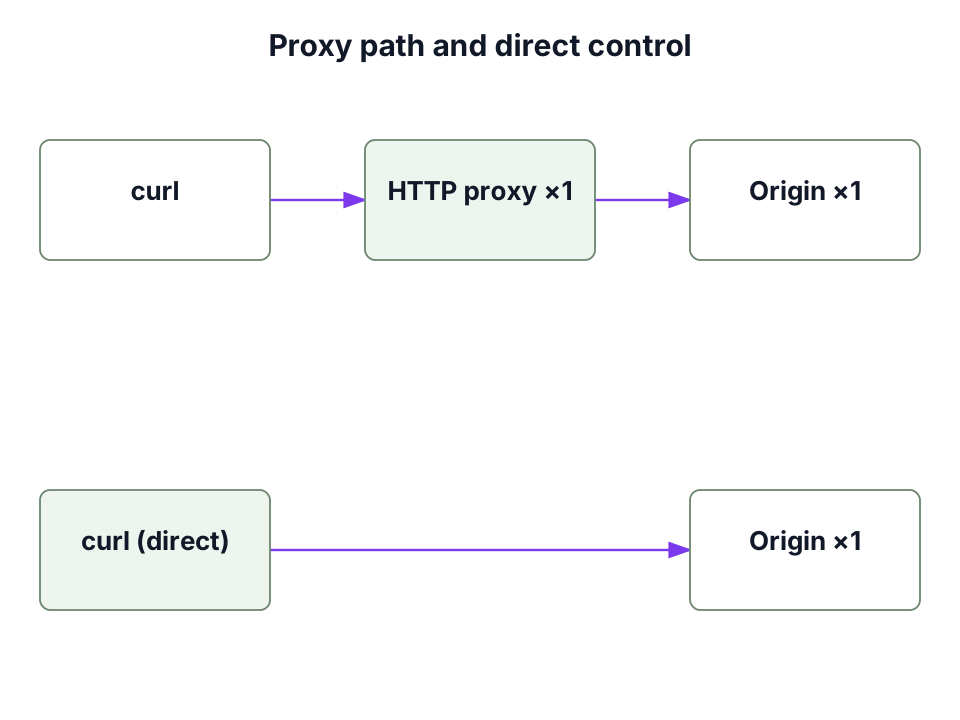
Both paths can return a correct response, which is why the command-line section compares two exits to prove the traffic went through the proxy.Open full-size figure
For SOCKS5 replace the whole proxy value with socks5h://proxy.proxy302.com:3333, including the scheme. Use the exact username and password from your resource card, separated by a colon.
The first command selects the configured proxy; the second explicitly disables proxies. Compare ip and country. On Windows run these commands in Command Prompt (cmd.exe); older Windows PowerShell drops empty quoted arguments, so naming curl.exe alone is not enough.
Scroll horizontally with the arrow keys to read all content.
What each request should show
Criterion
Response
Notes
Proxied request
ip, city and country are the proxy exit
country should match the region of the line you bought.
Direct control
ip, city and country are your local exit
A difference is a useful signal; also verify client settings and usage.
Both identical
Check for bypass or a shared exit; equality alone is inconclusive.
Follow the "exit IP never changes" row in the table below.
Read from the ipinfo.io response; different IP databases may locate the same exit slightly differently, so compare before and after within the same service.
Host, username and password belong to the asset itself: they change when you switch lines, regenerate or expire, so always trust what the workbench resource card shows now.
Give the credentials only to tools that need the proxy; never commit them to repositories, chats or script comments. When you keep proxy302.conf by hand, restrict the file to your own user (chmod 600 on POSIX, remove other users in the file properties on Windows) and delete it when done.
Expired or disabled assets cannot connect. Prepaid traffic uses the selected line quota; wallet PAYG uses the wallet balance and the supported billing mode. If credentials may have leaked, review usage and asset status before changing the line.
Tools solve three things: one-click switching, per-site or per-app routing, and multi-account isolation. Our own tools are the browser extension (simplest) and the helper tool (restricted networks); common market tools such as SwitchyOmega, Proxifier and antidetect browsers like AdsPower all take the same credentials.
Grab the package from "Downloads and setup" at the bottom of this page. Chrome users unzip it, open chrome://extensions, enable "Developer mode", click "Load unpacked" and select the unzipped folder; 360 browser users install the .crx directly. The Proxy302 icon appears in the toolbar when done.
Expected result: The Proxy302 icon is in your toolbar.
Sign in inside the extension
Click the icon to open the popup, click "Log in to your account" and finish signing in on the page that opens. Back in the extension your assets appear automatically — no host, username or password to type.
Expected result: The popup shows your account and assets.
Pick a country and connect
Dynamic lines pick country/state in the popup and click connect; static lines select the asset. The popup shows the live exit IP — when the region matches your choice, the proxy is already working.
Expected result: The exit IP shows the selected region.
Real screenshot of the official v1.5 extension (signed-out state). After signing in, the same popup picks a country, connects and shows the exit IP at the top.Open full-size figure
Can't connect from a non-overseas network? Run the helper tool
On some networks the extension cannot connect directly. Download the helper tool for your system from the bottom of this page, keep it running in the background, then open the extension settings and tick "Use helper tool" — the local IP is filled in automatically. The help center has illustrated steps per browser.
If you write code, continue with the Playwright and Selenium scene pages; compare lines before buying if you are still deciding; the extension and desktop helper tools are under "Downloads and setup" at the bottom of this page, with per-browser illustrated steps in the help center.
The extension cannot connect or fails to set the proxy
Check: Whether you are on a non-overseas network (the helper tool is required) and whether another proxy extension is running (they can conflict).
Next action: Run the helper tool and tick "Use helper tool" in the extension settings; disable other proxy extensions and retry.
System proxy is on but some apps bypass it
Check: Some apps ignore system proxy settings or carry their own network configuration.
Next action: Fill the proxy in that app's own network settings, or take it over per-app with Proxifier.
HTTP 407 (proxy authentication failed)
Check: Whether the credentials were copied whole (missing characters or stray spaces cause 407) and whether the asset expired or ran out of traffic.
Next action: Copy again with "Copy all" on the resource card and re-check asset status and remaining traffic.
Stop when: Do not hammer retries on 407; confirm credentials and asset state first.
Connection timeout or refused
Check: Match the protocol and port: HTTP 2222, SOCKS5 3333. no_proxy / NO_PROXY matches the target (here ipinfo.io), not the gateway.
Next action: Use the correct full proxy URL and the explicit bypass-control options shown above, then retry.
Responses come back but the exit IP never changes
Check: Whether requests actually go through the proxy: an extension rule that misses, or code that never passes the proxy option to the real client, silently goes direct.
Next action: Locate it with the step-4 comparison and confirm the client really uses the proxy.
Generating a proxy says there is no traffic
Check: For prepaid traffic check the selected line quota; for wallet PAYG check wallet balance and whether that product supports PAYG. These are separate funding sources.
Next action: Confirm the selected billing mode and its available funds before purchasing more traffic or topping up.
FAQ
Do I have to use the command line?
No. Browser users are done after the three extension steps; the command line is only how developers verify the gateway and write scripts.
Can the system proxy and the extension (or a tool) be on at the same time?
Keep one active at a time. Two stacked proxy layers easily detour or fight over traffic; use Proxifier for per-app routing or SwitchyOmega for per-site routing.
How do I choose between ports 2222 and 3333?
Follow the line's protocol: HTTP proxy uses 2222, SOCKS5 uses 3333. When a tool supports both, prefer SOCKS5; see the curl manual on socks5 versus socks5h for where DNS is resolved.
Sign in at proxy302.com and open the workbench: the resource card shows host and username in plain text, masks the password, and "Copy all" grabs everything at once.
The credential belongs to the asset itself; concurrency and reuse limits follow the purchase page and line notes. For multi-account operations plan one IP per account.
Proxy302 workbench and product configuration pages
Product observation · Checked:
Port rules from the public frontend source proxyEndpoint.ts (HTTP 2222 / SOCKS5 3333), consistent with the production facts file customer_proxy_entry; the resource-card host/username/password and Copy-all behaviour from the workbench rendering source. Behind-login screens were not re-tested in this pass.
Proxy302 official browser extension v1.5 (public distribution package)
Product observation · Checked:
Unpacked the Chrome extension v1.5 distributed 2026-05-29 and loaded it in a clean browser: the popup has a sign-in entry (web login, no manual credentials), country/state selection, one-click connect and a live exit IP display; the background works with the account session over the API. The extension UI ships Chinese and English.