claude.ai keeps spinning or won't load
Check Does Relay show connected? Are you in the window opened by Open browser?
Fix Turn on One-click boost again and click Yes; open a new window with Open browser. Close any other acceleration software first.
Updated
curl -x http://USER:PASS@HOST:PORT https://ipinfo.io/json
One Claude account, one fixed overseas static IP; the China leg is handled by the client's One-click boost. About 5 minutes on a computer.
Leg one runs from China to overseas. Connecting from a mainland network straight to an overseas proxy address is often unstable: the switch is on but the page keeps spinning. The Proxy302 client's One-click boost keeps this leg stable for you.
Leg two is the fixed overseas exit. Claude sees the static IP you bought, not your local network. Keep one Claude account on one IP and use that same IP on the web, the desktop app and the phone.
So the order is: buy the IP → install the client and turn on One-click boost → connect the way you use Claude (web, desktop, Claude Code, antidetect browser, phone) → check on ipinfo.io.
| Item | How to connect | Time |
|---|---|---|
| claude.ai in a browser | ① client Open browser | about 3 min |
| Claude desktop app (Windows / Mac) | ② client system proxy | about 3 min |
| Claude Code (terminal) | ③ HTTPS_PROXY to 127.0.0.1:17890 | about 2 min |
| Several Claude accounts in AdsPower or BitBrowser | ④ fill the proxy, or More → Send to AdsPower / BitBrowser | about 3 min |
| Claude app on a phone | ⑤ Shadowrocket chain, or the computer's LAN port | about 5 min |
①–④ all need the Proxy302 client installed on the computer with One-click boost on.
For Claude, choose the Claude ISP: dedicated to you, and a renewal usually keeps the same IP. Pick the country first (the US is the common choice) and keep the protocol on HTTP (Claude Code only accepts HTTP). If you already have a static IP, use that one.
Expected result The IP appears under My proxies in the console.
Download the Windows or Mac client and sign in with your Proxy302 account. Click Relay on the left, then turn on One-click boost; when the computer asks for confirmation, click Yes (on a Mac, enter your login password). Keep the client running while you use Claude.
Expected result You see One-click boost is on, and My IPs lists your IP.
Before continuing If antivirus software blocks it, allow the hosts change, restore any quarantined files and add the client's install folder to the trusted list.
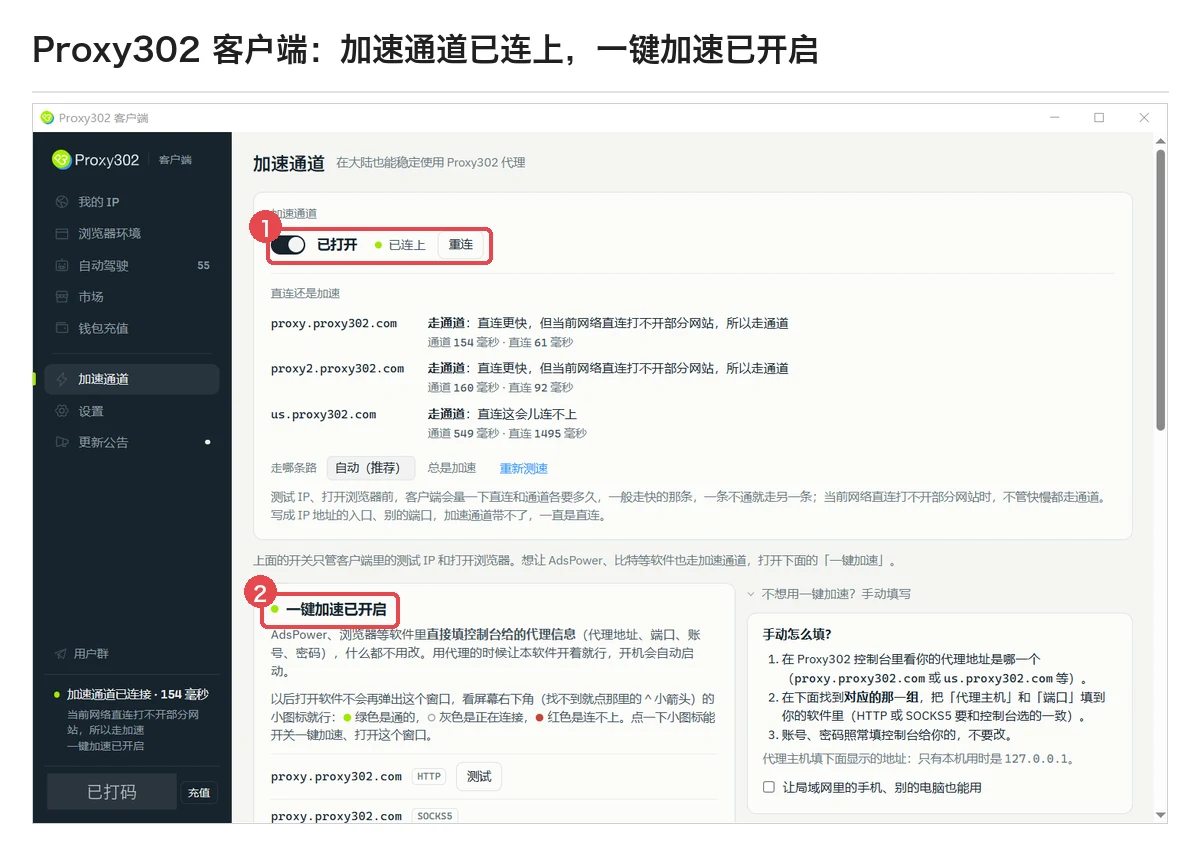
Find the IP and click Open browser. The client opens a new Chrome window that uses the IP you bought. Sign in to Claude from this window from now on.
Expected result ipinfo.io in this window shows your IP and country.
Open claude.ai in the same window and sign up or sign in. Do not sign in to the same account from another browser.
Expected result Claude opens the chat page normally.
The Claude desktop app has no proxy field of its own; it follows the computer's system proxy. In My IPs click More on the IP → Use as system proxy → Turn on, then click Set as this computer's system proxy.
Expected result The client shows the system proxy is on at 127.0.0.1:17890 (use what your client shows).
Before continuing Once it is the system proxy, every app that follows the system proxy uses this IP; turning the system proxy off or quitting the client restores the old setting.
Quit Claude completely (including from the taskbar or menu bar), then open it and sign in.
Expected result The Claude desktop app signs in and chats normally.
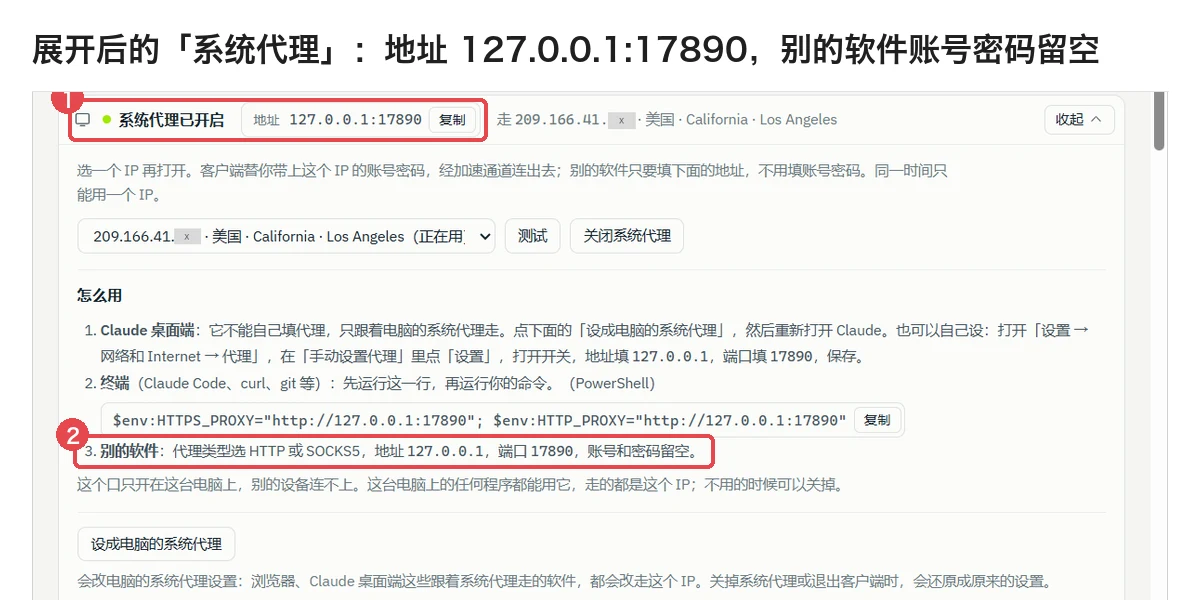
As in step ② above, use this IP as the system proxy and turn it on. The terminal uses that local address, with no username or password.
Expected result The client shows the system proxy is on.
Run the matching line below in PowerShell (Windows) or Terminal (Mac), then run claude in the same window. Claude Code supports HTTP proxies only, not SOCKS, and this address is HTTP.
Expected result In Claude Code, /status shows http://127.0.0.1:17890 on the Proxy line.
$env:HTTPS_PROXY="http://127.0.0.1:17890"; $env:HTTP_PROXY="http://127.0.0.1:17890"
claude
Use the port your client's system proxy shows.
export HTTPS_PROXY=http://127.0.0.1:17890 HTTP_PROXY=http://127.0.0.1:17890
claude
To make it permanent, put both variables in the env block of ~/.claude/settings.json.
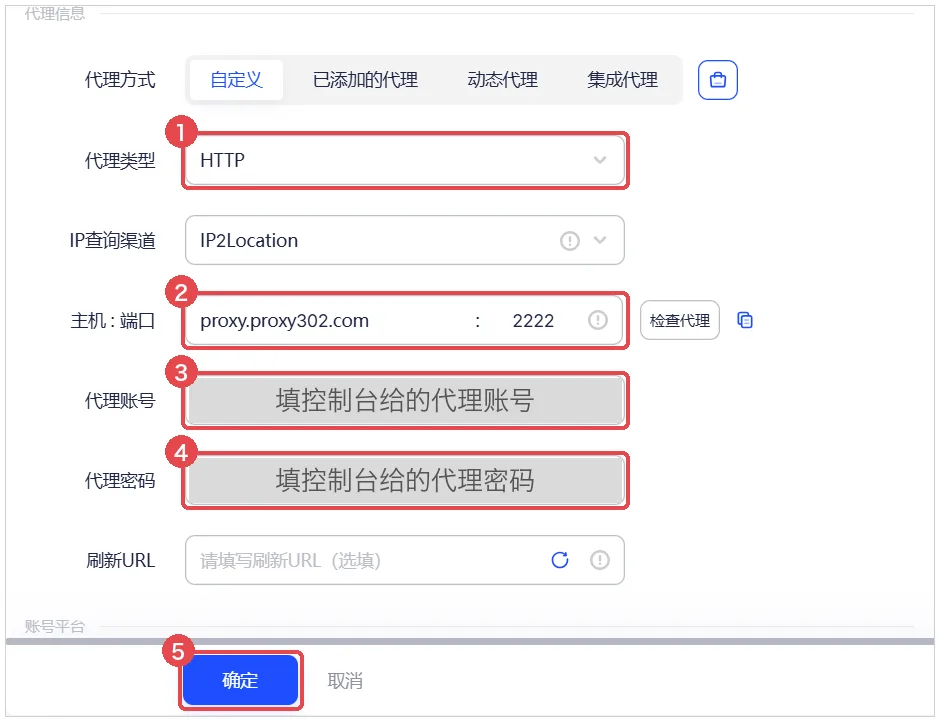
In My IPs click More on the IP → Send to AdsPower / BitBrowser and the client creates the profile for you (if the menu doesn't show it, fill it in by hand). By hand: in AdsPower click New profile → Proxy and copy the console values: type HTTP, host proxy.proxy302.com, port 2222, and this IP's username and password, then confirm. BitBrowser has the same fields.
Expected result Check proxy in the antidetect browser shows the country you bought.
Before continuing Keep One-click boost on; the address in the antidetect browser does not change. One profile per IP, and sign in to each Claude account in one profile only.
On the client's Relay page open the manual set-up, find the group that matches your console address, and note the port on the HTTP line (for example 12222; use what the page shows). In the antidetect browser enter HTTP, 127.0.0.1 and that port, with the console username and password (not blank).
Expected result Check proxy shows the IP you bought.
In Shadowrocket tap +, choose SOCKS5, enter the address, port 3333, username and password of this IP, and switch off UDP relay. Tap the node's ⓘ and under Proxy Via pick your own node that already opens overseas sites. On the home screen set Global Routing to Config, select the static IP node and switch it on.
Expected result ipinfo.io in Safari shows your IP; then open the Claude app and sign in.
On the client's Relay page open the manual set-up and tick the option that lets phones and other computers on the local network use it; note the computer's LAN address and the port on the HTTP line. On the iPhone go to Settings → Wi-Fi → ⓘ for this network → Configure Proxy → Manual, enter the computer's address and that port, turn on Authentication and enter this IP's username and password.
Expected result While the phone and the computer share the Wi-Fi, the Claude app uses the IP you bought.
Before continuing This only applies to this Wi-Fi; on mobile data the phone goes direct, so check you are on this Wi-Fi before opening Claude.
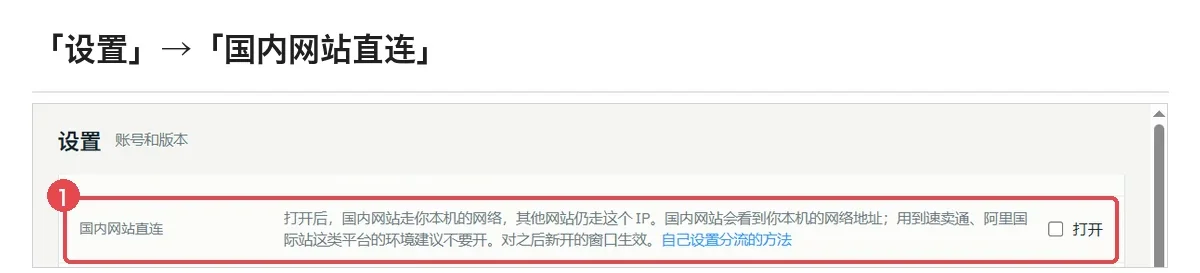
In the client's Settings turn on Chinese sites direct: Chinese sites use your local network while overseas sites such as Claude keep using the static IP. It applies to windows opened afterwards; if you use the system proxy, turn it off and on once.
Wherever you use Claude (the Open browser window, the antidetect profile, Safari on the phone), open ipinfo.io and check that ip and country match the IP you bought. The desktop app and Claude Code use the system proxy, so check with a browser on the same computer. The computer and the phone should show the same IP.
Check Does Relay show connected? Are you in the window opened by Open browser?
Fix Turn on One-click boost again and click Yes; open a new window with Open browser. Close any other acceleration software first.
Check Does ipinfo.io in the same window show the country you bought?
Fix If not, the traffic isn't using the IP: use the Open browser window on the web, and for the desktop app confirm the system proxy is set and restart it.
Check Is HTTPS_PROXY set in the window that runs claude? What does the Proxy line in /status show?
Fix Set the variable again in the same window and run claude; start it with http://, not socks5://.
Check Is the client up to date?
Fix Update the client; if that doesn't help, right-click the client icon in the system tray on Windows, or click it in the menu bar on a Mac, choose quit, reopen it and sign in with the client's own input boxes.
Check Has the IP expired? Did you copy an extra space with the username or password?
Fix Check the status and credentials under My proxies; if it still fails, open a ticket in the console with a screenshot.
No. One-click boost only stabilises the China-to-overseas leg; the exit Claude sees comes from the static IP you bought.
Yes. The same username and password work on a computer and a phone at the same time, with no extra purchase; HTTP (2222) and SOCKS5 (3333) can also be used at the same time. The target site may apply its own risk checks to one account on several devices; that is unrelated to the IP.
No one can promise that. Claude's account risk decisions belong to Anthropic, and no IP can guarantee an account won't be banned. A static IP keeps one account signing in from the same clean exit instead of a different country every day. See the Claude account checklist for what else to watch.
With Chinese sites direct on, Chinese sites use your local network at their usual speed.
No. The client already includes One-click boost and the manual ports. If you can't sign in to the client, the Fast Connect tool's One-click boost can stand in; don't run both boosts at once.
Continue with the way you use Claude.
Claude proxy is the Claude ISP: a dedicated native IP in the US, Frankfurt, Japan or London, 15 PTC for 30 days, HTTP for Claude Code — and Anthropic's region rules.
View options and pricingSix ways to use Proxy302 in China: client one-click boost, Clash, Shadowrocket, Android and fingerprint browsers, with the button names.
On a computer in China: install the client, click One-click boost, open the browser from My IPs.
How to run Claude Code behind an HTTP proxy: HTTPS_PROXY, NO_PROXY, settings.json for background agents, and the checks that show it works.
Put the Claude app on the same fixed IP as the web login: Wi-Fi proxy or client app, the limits of the system proxy and a check with ipinfo.io.
Borrow the client on your computer, or chain the static IP behind your own node on iPhone or Android.
Check the official supported list and your organization, where you physically are and what your connection shows, then your phone number and billing location.
What Unable to connect to API, ECONNRESET and Request timed out mean in Claude Code, and the order to check network, proxy, gateway address and certificates.
Twelve checks before and after you subscribe to Claude, each linked to the section that explains it.
ChatGPT from China: client One-click boost, then web, desktop app, Codex or phone on one static IP.
Gemini from China: client One-click boost, then Gemini web, AI Studio, Gemini CLI or phone on one static IP.
Cursor from China: client One-click boost, system proxy, http.proxy set to 127.0.0.1:17890 and HTTP/1.1 if chat hangs.
Setup guides Proxy302 publishes on GitHub on the same topic:
Product observation · Confirmed on:
Button names follow the client team's 21 November check of the 3.5.4 code: Relay, One-click boost, Open browser, More → use as system proxy, set as the computer's system proxy, send to AdsPower / BitBrowser, manual set-up, LAN sharing, Settings → Chinese sites direct. Screenshots are the Windows client on a test computer.
Official documentation · Confirmed on:
Read on 22 October 2026: Claude Code reads HTTPS_PROXY / HTTP_PROXY, supports HTTP proxies and not SOCKS; /status shows the proxy in use.
Create an account, top up once, then pick rotating residential, static ISP or datacenter IPs and have one running in your browser within minutes.