
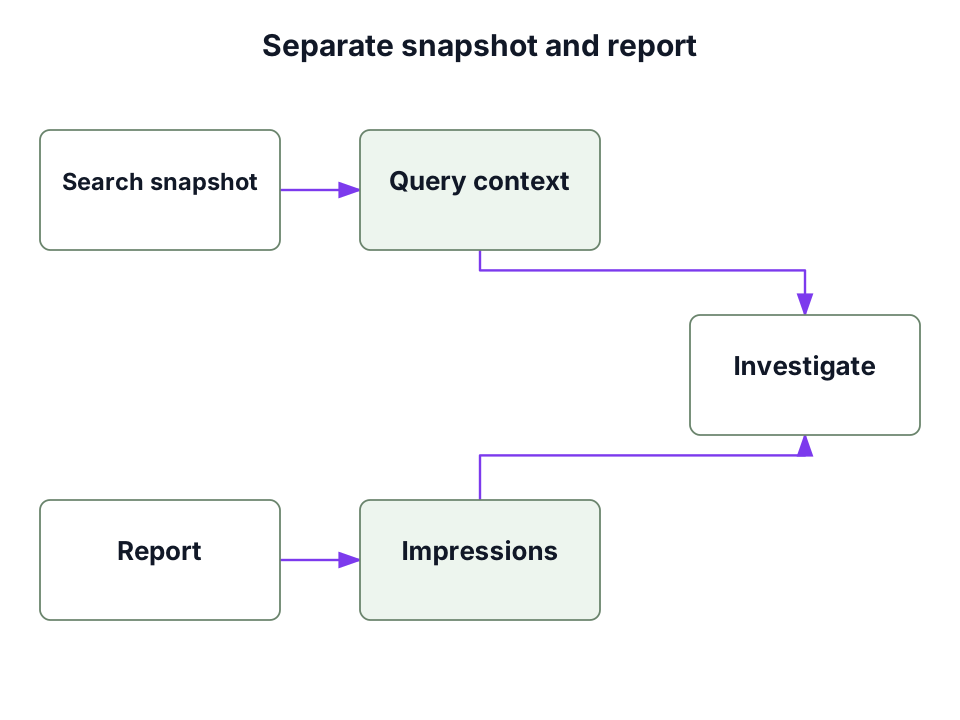
The rank changed after switching an exit
Check: Compare time, footer location, query, device, language and personalization conditions.
Next action: Report the observed difference; do not attribute causality to the exit alone.
Search from the target city and record rankings, featured snippets and local packs to judge real regional visibility.
Use a permitted regional observation when you need to inspect a specific result's visible title, URL or surrounding elements. If the question is how often your own site appeared or received clicks over a period, start with the Search Console report you are already authorized to view. Do not set up new account access just to follow this workflow.
Google identifies time, location, language, device and personalization as possible causes of differing results. Disabling personalization does not remove contextual effects. Its settings can change, so record the controls and footer location you actually saw instead of relying on a fixed click path.

Scroll horizontally with the arrow keys to read all content.
| Criterion | Keep with the result | Why it matters |
|---|---|---|
| Query and surface | Exact query text, engine, selected search type and any filters | A web result and an image result have different layouts |
| Context | UTC time, language, device/viewport, sign-in and observed personalization state | Time and context can change what is shown |
| Location | Requested exit region, observed exit and the search footer's location when available | A proxy country is not confirmation of the search service's chosen location |
| Result evidence | URL, title, element type, counting rule, visible scope and permitted capture | Ads and multi-link elements must not silently change the organic-link count |
| Completeness | Observed, not seen within recorded scope, blocked, timeout or unknown | Missing is not position zero |
Use the same counting rule for repeated snapshots. Preserve the raw evidence so another reader can understand the scope rather than assuming a universal rank.
For example: does an owned page's visible title differ between two recorded regional contexts? Choose the exact query and a limited result scope before viewing.
Keep query, language, search type and device stable. Use only permitted access, record the observed settings and footer location, and retain any unavoidable differences.
Record organic links separately from ads and compound result blocks. Do not click ads or trigger conversions. Keep a compound element's own links identifiable rather than counting all of them as ordinary organic positions.
Record the time and context for each observation. If blocked or incomplete, preserve the reason and stop or reschedule under the destination's rules. Do not rotate exits to push through a refusal.
Repeated comparable differences can justify checking an owned page's title, canonical or localization setup. They do not by themselves establish a ranking cause, traffic loss or the effect of a proxy.
Scroll horizontally with the arrow keys to read all content.
| Criterion | What it measures | Interpretation boundary |
|---|---|---|
| Recorded browser snapshot | One observed result layout under logged conditions | Your counting rule describes this capture only |
| Search Console average position | The topmost property/page result, averaged over recorded impressions | Not the rank from one fresh browser query |
| Search Console query table | Reported query rows under selected filters | Anonymized and other omitted rows mean it is not a full query census |
Search Console generally assigns performance data to canonical URLs. A URL variation in a snapshot may not be a separate report row. A missing recorded position must not be replaced with zero.
Illustrative case, not a live rank measurement: your captured page shows one organic link after a compound block, while the owned report gives a different average position for the date range. First compare search type, country/device filters, time window and canonical attribution. Then check whether your snapshot counting rule treated the block differently. Neither number needs to be wrong.
If the original observation is unavailable, label it missing. Do not recreate it from memory, a later search or a proxy location label. Keep a discrepancy open until the underlying records support a narrower explanation.
Check: Compare time, footer location, query, device, language and personalization conditions.
Next action: Report the observed difference; do not attribute causality to the exit alone.
Check: Check the captured scope and whether the request was complete.
Next action: Write “not seen within this scope” or missing, never a fabricated zero rank.
Check: Check the report filters, privacy omissions, row limits and canonical URL attribution.
Next action: Treat the table as partial evidence; proxy sampling cannot recover omitted historical queries.
Check: Measurement design and the implementation of a scheduled request are separate responsibilities.
Next action: Use the search-monitoring automation guide for its bounded code and error checks.
Consider residential access only when a permitted regional network view adds evidence. An existing authorized report or direct observation may be enough. This page does not measure search demand, AI citations or ranking improvements.
Official documentation · Checked:
Official documentation · Checked:
Official documentation · Checked:
Create an account, top up once and pick an exit in 195+ countries — residential, static ISP or datacenter.