
The page still shows the old region
Check: Check the site's selector, cookies, account state and displayed location.
Next action: Record the mismatch. Do not claim the proxy reproduces a local customer's view.
Collect regional prices, plans and catalogues on local residential IPs without your own location skewing the comparison.
Suppose you are deciding which region needs a follow-up interview about a service plan. Record whether the public page lists the same feature bundle and billing period in both places. A missing feature or different plan name justifies checking the provider's regional documentation; it does not establish that customers prefer one offer.
Use the site's official regional selector or public export first when it provides the required view. Consider a residential exit only when a permitted regional network observation adds useful information. An exit cannot establish delivery eligibility, tax treatment or an account's purchasing rights.

Scroll horizontally with the arrow keys to read all content.
| Criterion | Record explicitly | Do not silently substitute |
|---|---|---|
| Offer identity | URL, provider, plan or product ID, variant, bundle and billing period | A similar name for the same product |
| Displayed terms | Original currency, tax inclusion, shipping destination or eligibility text, availability wording | A converted price for a final payable total |
| Viewing conditions | UTC time, page locale, regional selector, device, sign-in/cookie state and observed exit | Proxy country for the site's confirmed region |
| Evidence and gaps | Saved page or permitted screenshot, exact field, missing or blocked status | An inaccessible page for “not offered” |
Leave a field unknown when the page does not disclose it. Do not complete the record by purchasing, logging in or guessing a checkout total.
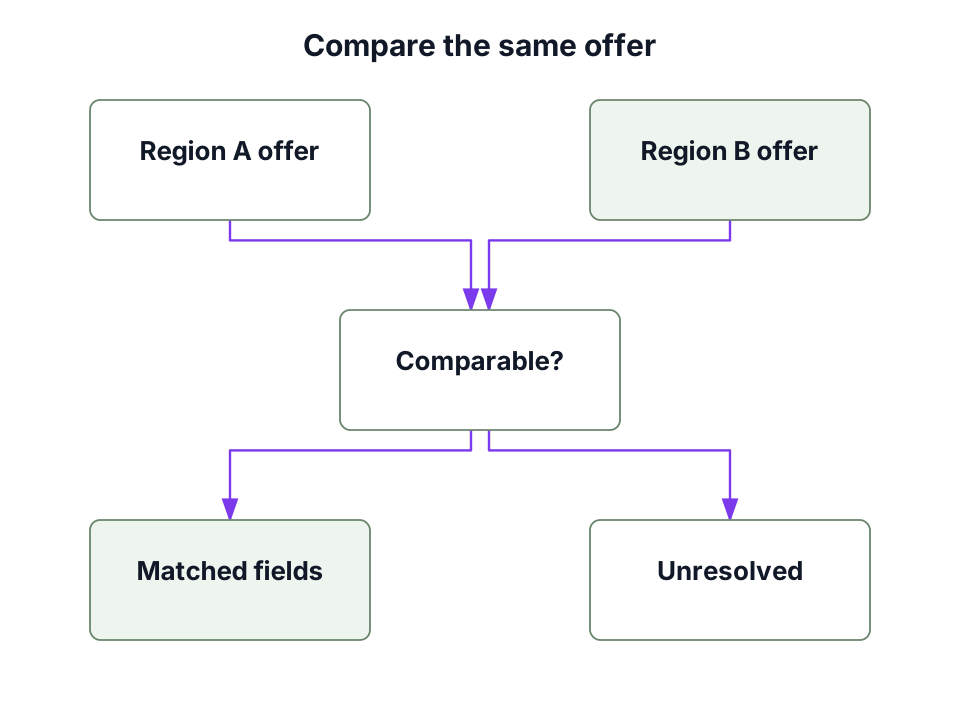
Choose the same public offer in two named regions and a narrow observation window. Write the intended decision before collecting: for example, which regional plan needs a provider-documentation check.
Keep language, device and sign-in state consistent where possible. Record deliberate differences. Note the site's displayed region separately from the exit region; if they disagree, preserve both.
Keep the original URL, timestamp and permitted page evidence. Mark fields comparable, different-but-explained or unresolved. Record refusal, timeout and missing content as collection outcomes.
Repeat the same bounded observation in a later recorded window. If the page changed, preserve both versions; do not overwrite the first sample or average incompatible offers.
A reproducible public difference can support a documentation review or a request for clarification through your authorized process. Demand or market-size decisions need other evidence.
Illustrative worksheet, not a live observation: Region A shows a monthly plan; Region B shows an annual bundle with a different feature allowance. Record both, but do not label B cheaper by dividing one displayed figure. First establish an equivalent bundle, billing basis and tax treatment. If no matching offer exists, report that the comparison unit differs.
If both pages list the same public feature and the same billing basis, you can report that those fields matched at the recorded times. You still have not observed purchase eligibility, actual fulfilment or buyer demand.
Google Trends can complement an offer review with sampled relative search interest. Its scores are normalized to the selected time and geography; equal scores in two regions need not represent equal numbers of searches. Low-volume terms may show zero. Keep the selected topic or query, time range and geography with any exported chart. Trends alone does not give sales or market size.
Check: Check the site's selector, cookies, account state and displayed location.
Next action: Record the mismatch. Do not claim the proxy reproduces a local customer's view.
Check: Compare variant, billing period, currency, taxes, delivery terms and timestamp.
Next action: Treat a changed comparison unit as a new observation. Use the price-monitoring guide for a repeated numeric check.
Check: Separate access failure from a confirmed public statement that an offer is unavailable.
Next action: Preserve an unresolved status and stop at the site's access rules.
For seller account operations, continue to the ecommerce guides. Use the price-monitoring guide to build an automated price series, or SEO monitoring to study queries and search results.
Official documentation · Checked:
Create an account, top up once and pick an exit in 195+ countries — residential, static ISP or datacenter.