FIELD NOTE
The short answer
The useful question is not “which proxy is best?” It is “what should the destination see, and what does the workflow need to preserve?” A residential proxy uses an IP associated with an access ISP or consumer network. A datacenter proxy uses hosting infrastructure. That difference affects the network signals available to a destination, but it does not guarantee acceptance, anonymity or compliance.
If the task is a permitted regional observation, a browser session that must keep one endpoint, or a workflow where ISP context is part of the test, start with residential and verify the exit. If the task is development, QA, monitoring or high-volume work on a target that allows datacenter traffic, start with datacenter and measure the route you actually receive.
FIELD NOTE
What the two labels describe
“Residential” describes the network context associated with the address, not a magic trust score. IP intelligence products can expose an ISP, organization, connection type, ASN and autonomous-system organization. MaxMind documents these as separate fields, and its product tiers do not all expose the same fields. That is why “the lookup says ISP” is a clue to inspect, not a complete verdict.
Datacenter routes are associated with hosting or cloud infrastructure. A hosting flag, ASN organization and reverse-DNS context can make that origin easier to identify. That is not automatically bad: it is often exactly what a monitoring or test workflow needs. The mistake is buying a datacenter route for a task whose measurement depends on an access-ISP context, then blaming the IP when the experiment was mismatched.
FIELD NOTE
Compare the task, not the adjective
The table is a starting point. The final choice should come from a small test bundle, not from a pool-size headline.
| Workflow need | Better starting point | Why | Verify before scaling |
|---|---|---|---|
| Regional storefront or ad observation where ISP context matters | Residential | The network origin is part of the observation | Country/city, ASN, hosting flag, cookies and device context |
| Multi-step browser session or support reproduction | Static residential or another stable route | Continuity is more important than a fresh exit | Same observed IP across the required session window |
| High-volume QA, uptime checks or public monitoring | Datacenter | Predictable infrastructure and easier capacity planning | Target policy, rate limits, latency and error rate |
| Independent requests where each request can stand alone | Rotating residential or datacenter | Rotation is a session choice, not a quality guarantee | Whether endpoint changes invalidate the measurement |
| Search-visibility monitoring | The least expensive route that matches the test design | Query, locale, device and time often matter as much as IP type | Store query, market, device, route and timestamp together |
FIELD NOTE
A four-signal verification routine
- Record the observed exitSend a request through the real endpoint to an IP-echo service such as https://ipinfo.io/json. Keep the timestamp, protocol, status code and elapsed time. Do not use an endpoint copied from a mock screen or an old article.
- Inspect ASN and organizationRecord the autonomous-system number, AS organization, ISP and hosting classification. RIPEstat exposes registration and routing context for IPs and ASNs; MaxMind documents ASN, ISP and organization fields. Preserve raw responses because datasets can disagree or update at different times.
- Add an independent risk signalIPinfo exposes limited is_anonymous and is_hosting flags. IPQualityScore exposes proxy/VPN/Tor flags, connection type and a fraud score; its thresholds are that provider’s scoring guidance, not an industry-wide definition. Report disagreement instead of averaging it into a made-up clean number.
- Repeat the connectionRun at least three independent connections and one session-length check. Record whether the observed IP changes, whether the region stays aligned, and which failures repeat.
FIELD NOTE
What our existing Proxy302 evidence does—and does not—show
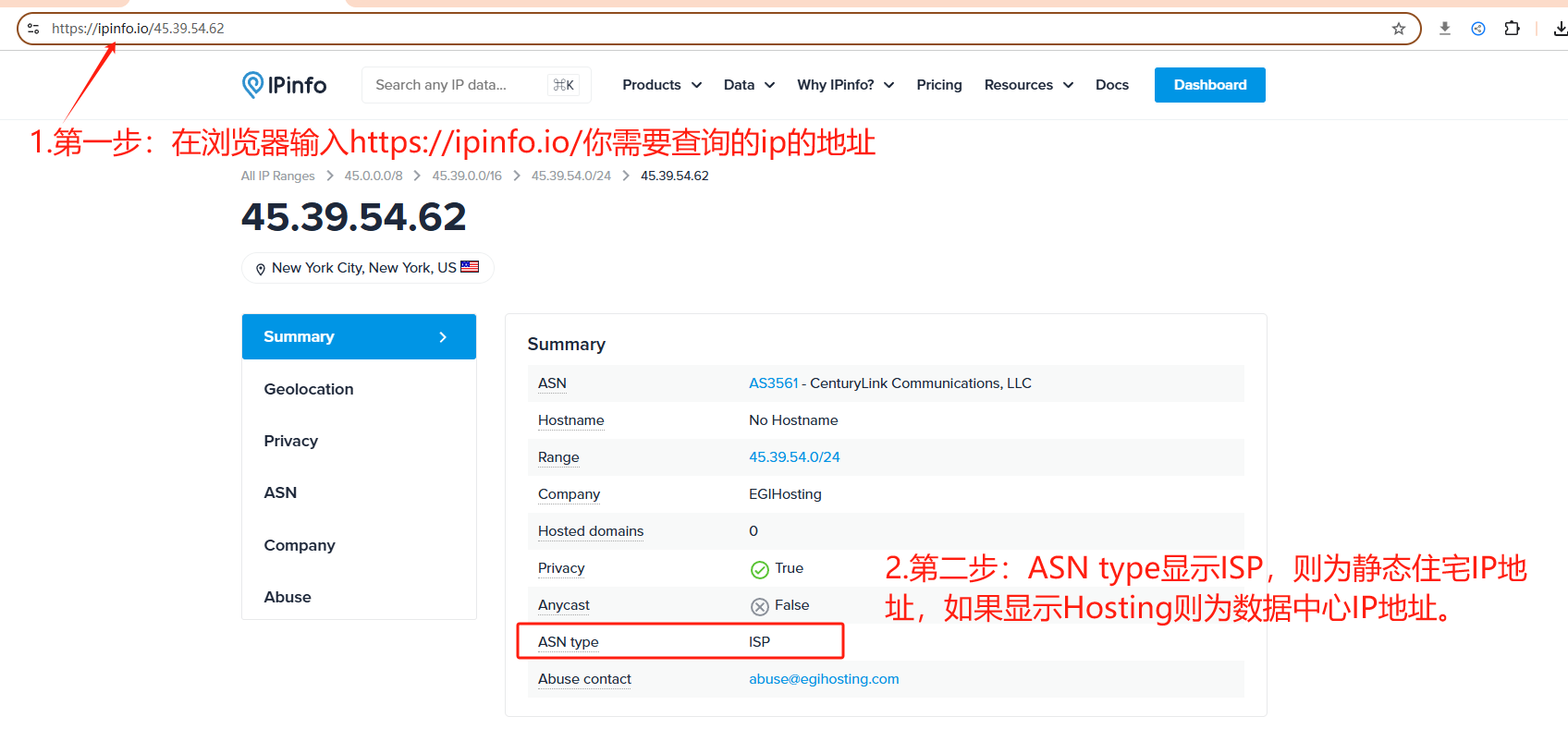
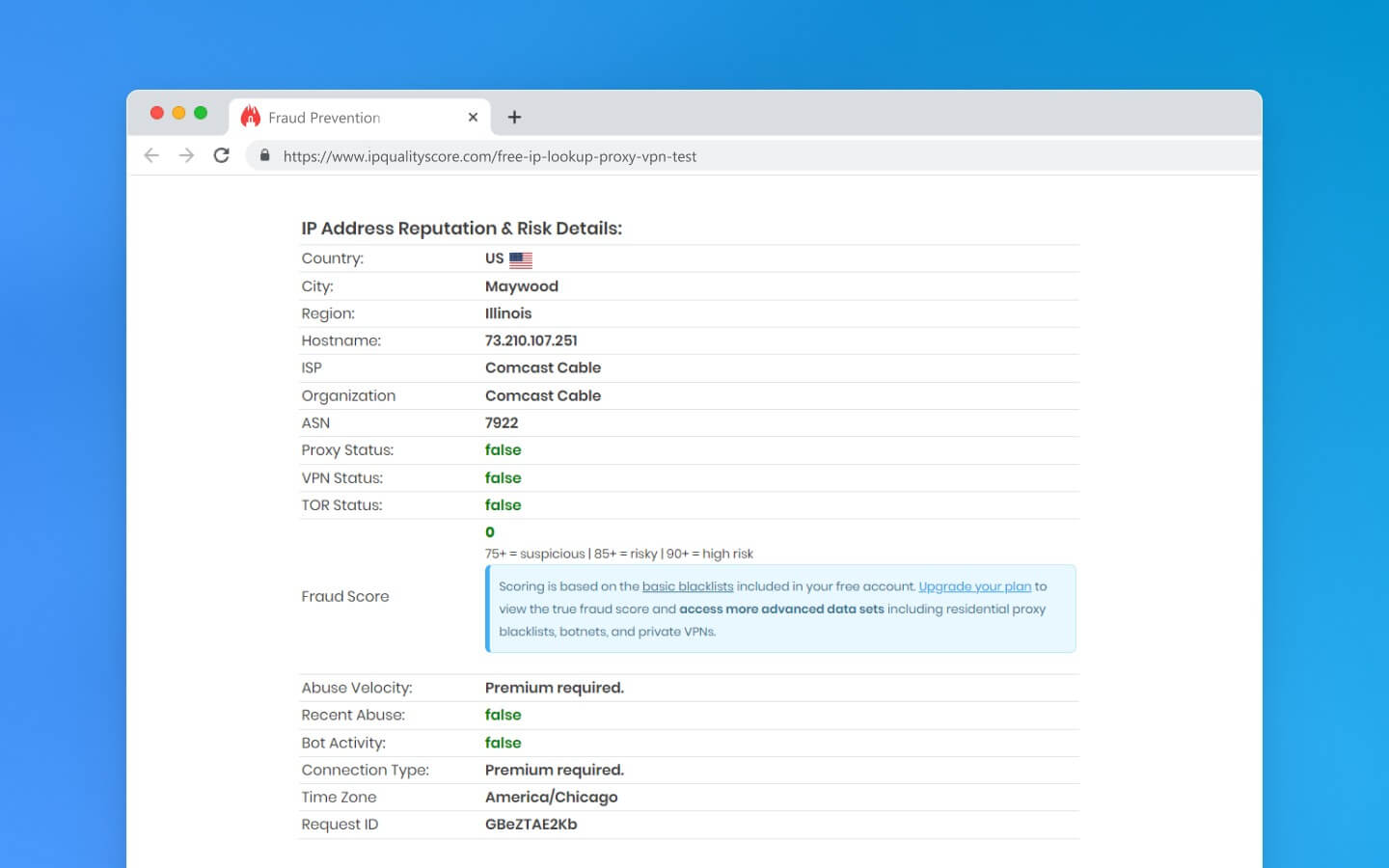
Proxy302 already has two inspection screenshots in the public site materials. One IPinfo capture shows 45.39.54.62, ASN AS3561, EGIHosting and an ISP ASN type. A separate IPQualityScore capture shows 73.210.107.251, Comcast Cable, proxy/VPN/Tor set to false and a fraud score of 0. They are useful examples of the fields an operator should inspect.
They are not current pool-level proof. The captures do not include a timestamp, request parameters or a binding to a current Proxy302 endpoint. We therefore keep them as inspection examples and leave the live comparison open until a current residential endpoint and datacenter endpoint are tested under the same conditions. That limitation is part of the result; hiding it would make the page less trustworthy.
FIELD NOTE
Protocol is a separate decision
HTTP and SOCKS5 answer “how does the client talk to the proxy?” Residential and datacenter answer “what network context does the exit belong to?” RFC 9110 defines HTTP CONNECT as a way to establish a tunnel and describes the successful switch to tunnel mode. It does not say that a CONNECT endpoint is residential or datacenter. Choose the protocol your client supports, then test the exit IP as a separate step.
FIELD NOTE
A decision rule you can reuse
For a permitted market-research workflow, see the market research workflow. To compare route options, start with rotating residential routes and datacenter routes. If session continuity is the real constraint, read rotating vs sticky sessions.
- 1Write down the target’s permission and the observation you need.
- 2Decide whether continuity or fresh exits matter more.
- 3Choose the smallest route class that can answer that question.
- 4Verify exit IP, ASN, ISP/organization, hosting and risk signals.
- 5Repeat before increasing request volume.
FIELD NOTE
FAQ
Are residential proxies always better?
No. They are a better fit only when the task needs an access-network context and the extra verification is justified. Datacenter routes can be the correct choice for predictable monitoring, QA and development.
Which type is faster?
There is no universal winner. Measure the actual endpoint from the actual client and region. A fast route that produces the wrong network context is still the wrong route for that experiment.
Can an ASN lookup prove an IP is residential?
It can provide a strong clue, but not a complete verdict. Combine ASN/organization with hosting, anonymous/proxy and risk signals, then repeat the test.
Does SOCKS5 make a datacenter IP residential?
No. SOCKS5 is a transport/proxy protocol. It does not change the network ownership of the exit address.
Can a residential label guarantee a clean IP?
No. Risk, abuse history, target policy and session behavior still matter. Record the evidence and the limits of the test.
CONTINUE THE DECISION
Next useful Proxy302 pages.
SOURCES